

Clinton Academy
Share this page
Clinton Academy was constructed in 1784 with funds contributed by local citizens at the request of the Reverend Samuel Buell, pastor of the East Hampton Presbyterian Church and soon to be first Headmaster of Clinton Academy. In addition to running the academy and the church, Buell is credited with the founding, or vision, of the Academy. The Academy holds the distinction of being the first chartered academy in New York State, by the Board of Regents.
The Academy opened its doors for classes on January 1, 1785. The founders of Clinton Academy were greatly influenced by the intellectual enlightenment in France and designed a curriculum with three basic departments: The Common School Department, the English Academical Department, and the Classical Department. Remarkably Clinton Academy was a co-educational institution preparing young men for college or for careers such as sea-faring or surveying, and educating young women in spiritual reading and in the finer points of being a lady. A college education was not available to a woman at that time, so Clinton Academy would have been the highest academic level available to a girl living in New York in the 1780’s.
The entire building was devoted to academics. Instruction was in Latin with some Greek and French. Children who came from out of town to attend the Academy boarded with families in the village. Students came from many areas on the East Coast, such as Long Island, New York City, New Jersey, and Connecticut. In the Academy’s greatest year, 1815, when it attracted 156 students, some students came from as far as the West Indies Colonies to study at the Academy.
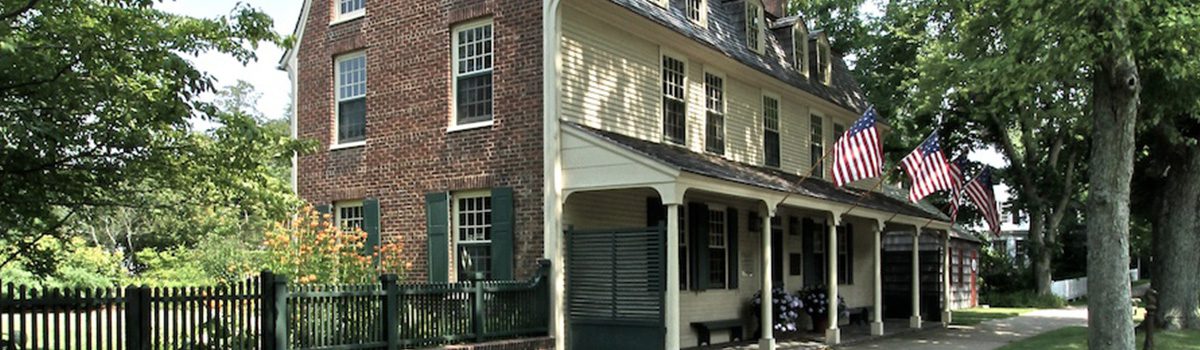
Clinton Academy is one of the most dramatic structures within the East Hampton historic district. Originally designed for continuing education, the Academy now serves as a museum and at present, houses some “Treasures” from the collections of the East Hampton Historical Society. Viewed from the exterior, this late Georgian style public building, constructed of brick and wood with a gambrel roof and a symmetrical front facade, is reminiscent of eighteenth century educational buildings found on both the Yale and Harvard campuses.
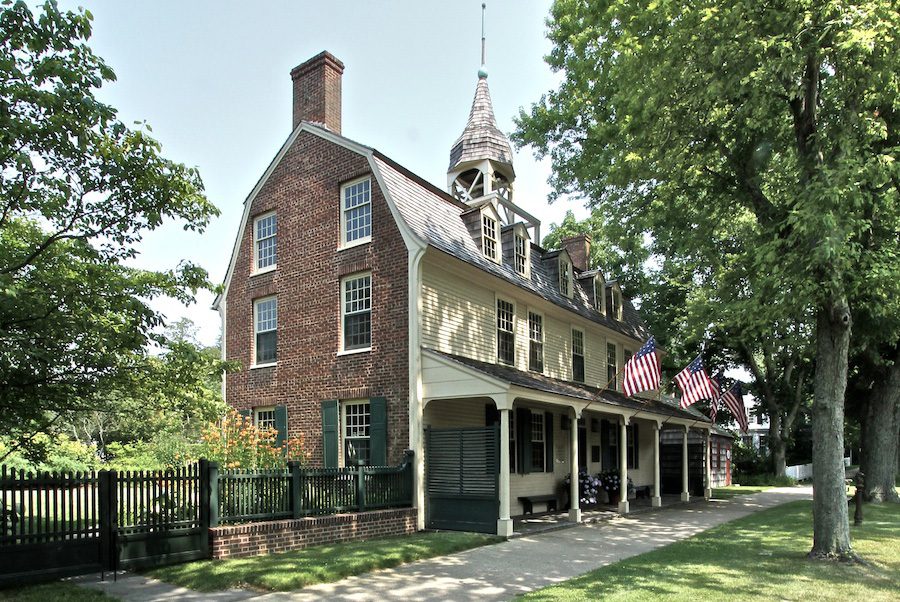
Many educational buildings of this day possessed Georgian characteristics such as Clinton Academy’s paneled front door which is centered between an equal number of windows on either side. Be sure to go outside and look for the early graffiti etched in some of the window panes. A traditional Georgian structure contains double hung windows aligned vertically and horizontally, each of which contain 6-12 small window panes per sash. At Clinton Academy the windows are in keeping with the Georgian style architecture. Gambrel roofs, such as the one on Clinton Academy, are found primarily on northern Georgian structures and provide more attic space or an expanded sleeping area. The dormers (protruding windows in the attic) are characteristic of a popular adaptation of the Georgian style which occurred after 1750. The cupola, projecting above the roof, is a common Georgian feature on public buildings.
Looking up to the cupola one can view the bell that was given to the school by the first governor of New York, Governor George Clinton. Governor Clinton chartered the school in 1786 and presented the bell which still hangs in the belfry to this day. Walking to the rear of the property one can enjoy the wildflower garden installed by the Garden Club of East Hampton.
By 1881 the state dissolved the chartered Academy system and the school reverted to the Trustees. The doors to Clinton Academy closed and the building was altered significantly (1881-1886) to serve as a community center known as Clinton Hall. A large wing, designed by Jarnes Renwick, Jr., was added on the southern end, and was used to house plays, operas, concerts, art shows, etc. Town offices were also installed in the “old” part of the building. Other sections of the building were rented for such things as music and dancing lessons, art studios, and the East Hampton Star newspaper offices. In addition, a library was also set up in some of the rooms.
In 1921 Clinton Academy was restored, as accurately as possible, to its 1784 appearance by Mr. and Mrs. Lorenzo E. Woodhouse, East Hampton’s major benefactors. The restoration work began in 1919 and took two years to complete. The work was performed under the supervision of Architect J. Greenleaf Thorp. The eighteenth century “restoration” of 1921 was the first attempt at an historic restoration undertaken by a non-profit organization in East Hampton. The restored building was then leased to the newly created East Hampton Historical Society for 99 years in 1921.
The structure as well as the exhibits may be viewed at any time by calling the East Hampton Historical Society’s administrative office, 631-324-6850.
Follow us on our social media
