

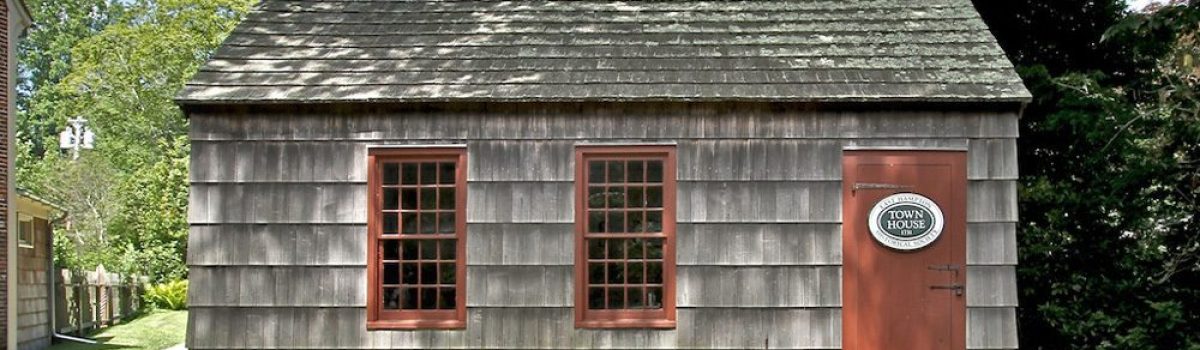
Town House, Circa 1731
Share this page
Unique among Long Island buildings, the Town House is the only existing town government meeting place to survive from the Colonial period. It is also one of the oldest schoolhouses on Long Island since this was a second function of the building.
Throughout the 18th-century the Town Trustees, who met at Town House, held considerable power in determining the affairs of the township. They established and collected taxes, passed local laws, administered public lands, maintained the church and schoolhouse, and hired the minister and teacher.
Education, however, was far from the first priority for the Puritans. Most families had only one book, the bible; and the school was dismissed during the months of January, February, and March (the whaling season) each year so that even the children could help in the carving up of whales. The teachers rarely, if ever, had a very extensive education and there were virtually no textbooks for the students (nor, for that matter, much paper); much of the learning was done by copying on slate. The course of study was very basic: reading, writing, and enough arithmetic to keep an account book. Another subject was sewing, which was taught to both the girls and the boys. One’s education was usually completed by age 13 or 14.
One feature sharply distinguishes the early schooling from our modern schooling: Corporeal discipline. Memoirs written by ex-students of this school have provided some colorful examples. One teacher was known for “washing” students ears out with a hot corn-cob when the students were not listening. Another was famed for his custom of having boys go outside to cut their own switches off trees with which they were beaten upon their return. Other punishments included being locked in a closet, tied to a chair, and thrown bodily into the snow.
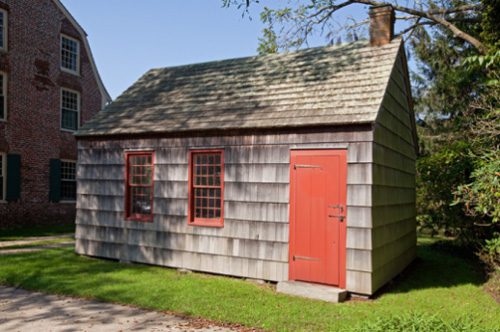
At night, after the school had been dismissed, the building was used for town meetings. The Puritans were very civic-minded, and in East Hampton they had an interesting system of forced democracy. One man would stand out on the Village Green and sound a roll on a drum. This would summon the townsmen to a meeting; if they did not come, they were fined several shillings.
Even after the building was no longer used as a school, after 1845, it was still used as a meeting place for the town trustees. After the 1880’s Town House was used as a barber shop, and an interior decorator’s studio. The building also served as a town welfare headquarters during the depression, and as a meeting room for scout troops.
The East Hampton Historical Society acquired the Town House in 1958 and moved it to a lot adjacent to Clinton Academy. The building was originally located on the north end of the common, and was moved to three other locations before its final site next to Clinton Academy.
The desks exhibited are from the various schools of the town, including Gardiner’s Island. Today the building is used for an interpretive exhibit of period school furnishings and accessories and is interpreted circa 1860.
Follow us on our social media
